Try the four color theorem with six map puzzles
Can every map be colored with four colors? Work through six printable map puzzles, compare your coloring with the answer key, and see what makes each minimum count necessary.
Six original maps · Separate answer keys · A4 and US Letter PDFs · No account
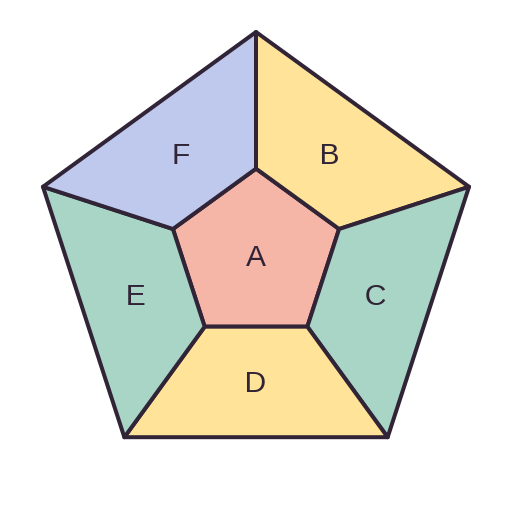
Start with the rule for neighboring regions
A shared edge makes two regions neighbors, so color that pair differently. A single-point touch does not count as a shared border, and those regions may match.
For any finite planar map made of connected regions, the four-color theorem guarantees an assignment using at most four colors when edge-sharing areas must differ. It does not require every map to use four. The examples here include layouts that can be completed with two or three.
Read the theorem’s formal statement and proof discussion at the proof authors’ explanation at Georgia Tech.
Check the difference between a corner and a border
In map 1, A meets D at only one point, so those two regions may match. A and B share an edge and need different colors; alternating two colors works for this layout.
In these activities, keep the area beyond each diagram uncolored. Count only the lettered areas and leave the unmarked exterior out. Each letter identifies one connected region. These diagrams are schematic examples rather than maps of countries.
A working assignment proves that this many colors will do. To establish the minimum, also show why one fewer cannot work.
Six maps to color and compare
Try crayons or colored pencils, or label regions with numbers 1–4. Reuse a color wherever two areas do not share an edge. Decide on an answer before opening the key; renaming the colors can produce another valid solution.
1. Corners do not count
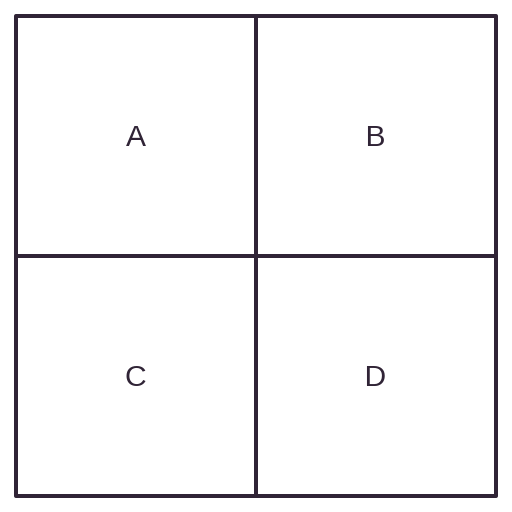
A and D meet at a point, so they may match. A and B share a side, so they must differ.
Open answer for puzzle 1
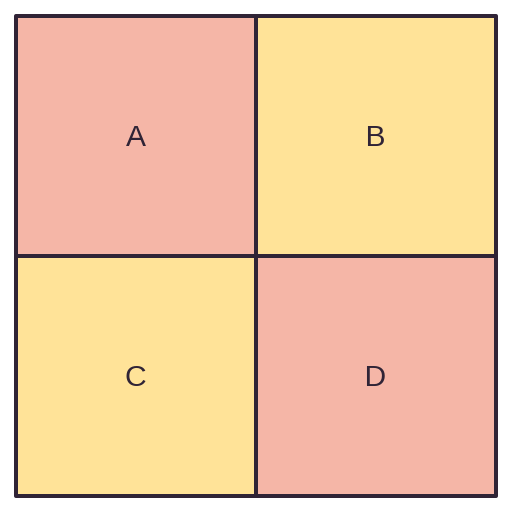
Fewest colors: 2. At least two colors are needed because A shares a border with B. The checkerboard uses two.
Numbered key: A=1, B=2, C=2, D=1. Equal numbers mean the same color.
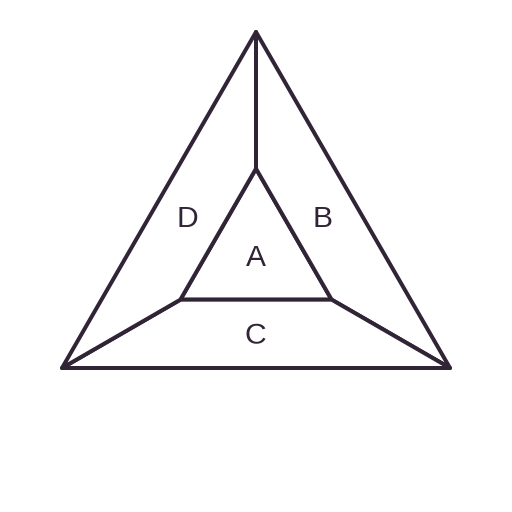
2. Three neighbors
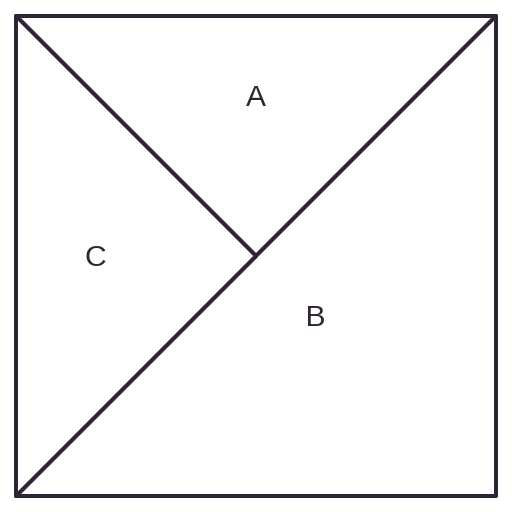
Follow the three lines into the meeting point. Each pair shares a line, not just the point.
Open answer for puzzle 2
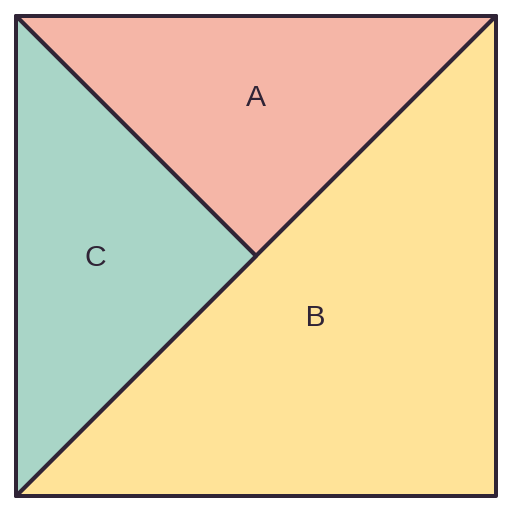
Fewest colors: 3. A, B and C all share borders with each other. That triangle of neighbors needs three colors.
Numbered key: A=1, B=2, C=3. Equal numbers mean the same color.
3. More regions, same two colors
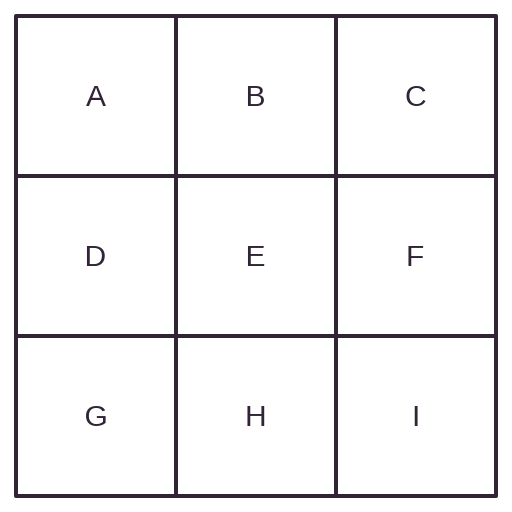
There are nine regions, but only horizontal and vertical neighbors matter. Try an alternating pattern.
Open answer for puzzle 3
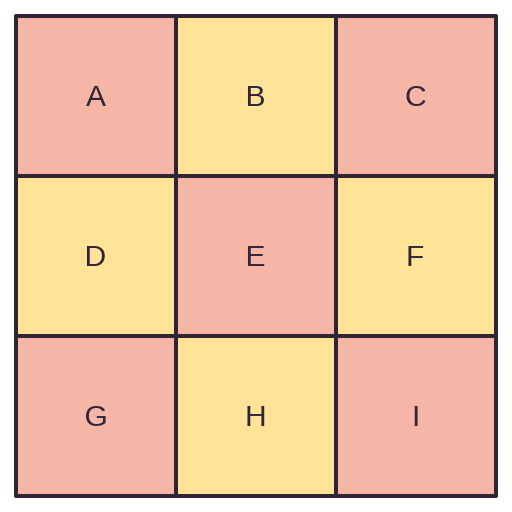
Fewest colors: 2. A and B force at least two colors. Alternating by row and column colors all nine regions with two.
Numbered key: A=1, B=2, C=1, D=2, E=1, F=2, G=1, H=2, I=1. Equal numbers mean the same color.
4. An even ring
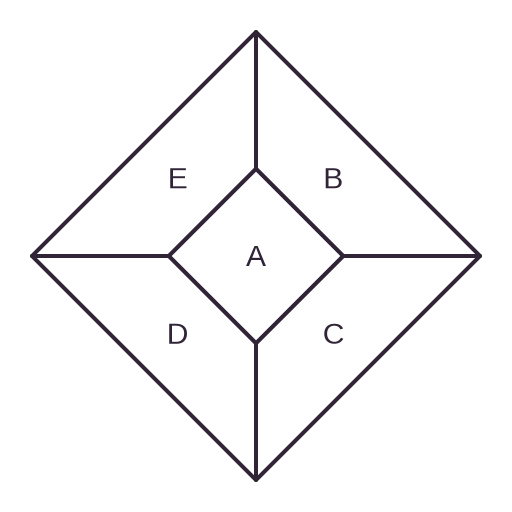
Alternate two colors around the four outside regions. What can you use for the center?
Open answer for puzzle 4
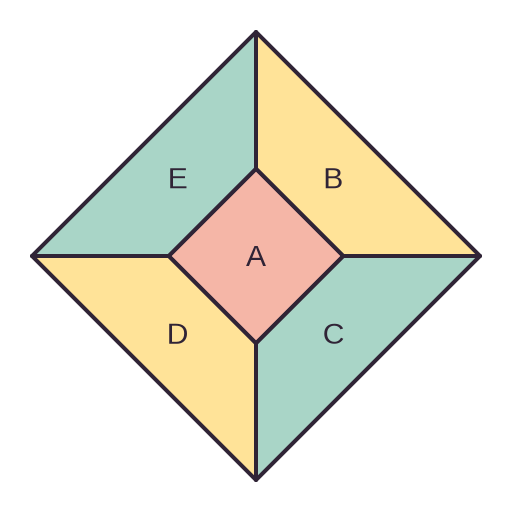
Fewest colors: 3. A, B and C are pairwise neighbors, so two colors cannot work. The even outside cycle uses two colors; A uses a third.
Numbered key: A=1, B=2, C=3, D=2, E=3. Equal numbers mean the same color.
5. Four mutual neighbors
Every region shares a border with every other region. Try to find a pair that can reuse a color.
Open answer for puzzle 5
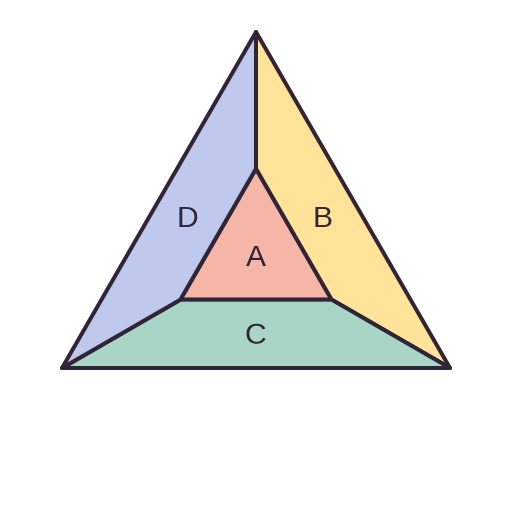
Fewest colors: 4. All six pairs among A, B, C and D share a border. Four mutually adjacent regions require four different colors.
Numbered key: A=1, B=2, C=3, D=4. Equal numbers mean the same color.
6. An odd ring
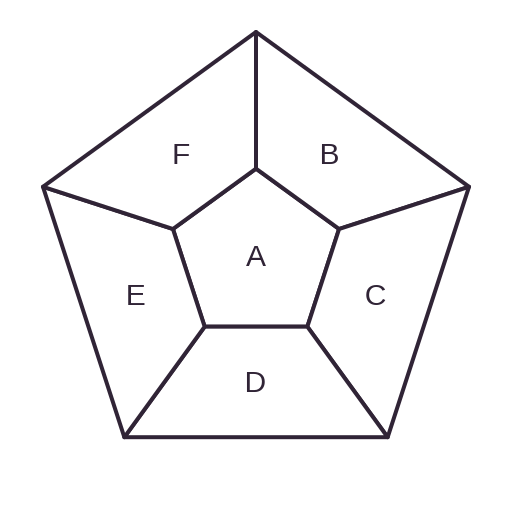
Try alternating two colors around the five outside regions. Watch what happens at the last border.
Open answer for puzzle 6
Fewest colors: 4. The outside five-cycle cannot alternate just two colors, so it needs three. A touches every outside region and needs a fourth.
Numbered key: A=1, B=2, C=3, D=2, E=3, F=4. Equal numbers mean the same color.
Print a worksheet pack or answer key
Each printable file runs three pages, with two diagrams on each sheet. Worksheets leave room to note a color count and explain the choice. The answer key pairs colors with numbers, so it remains readable in grayscale.
| Paper | Puzzles | Answers |
|---|---|---|
| A4 · 210 × 297 mm | ||
| Letter · 8.5 × 11 in |
Select A4 or US Letter to match your paper, then set the print scale to 100% (actual size). Hold back the answer sheets until the group has compared its solutions.
A short activity for a group
- Review the edge-sharing rule, then decide if A and D count as adjacent in puzzle 1.
- Pair up: have one person fill the map while the other audits each shared edge.
- Before checking the key, discuss which adjacent regions make a lower color count impossible.
- Look at both rings and describe how adding the central area affects the number of colors needed.
If choosing colors is inconvenient, place small paper markers numbered 1–4 over the regions. This lets a group try different assignments without coloring the printed map.
How many colors does each map actually need?
The minimum counts in pack v1.0.0 are 2, 3, 2, 3, 4 and 4, in puzzle order. A computer check tried every assignment with fewer colors and found a valid assignment at each stated minimum. These short arguments explain the same results without a computer.
- 1. Corners do not countMinimum: 2 colors
- At least two colors are needed because A shares a border with B. The checkerboard uses two.
- 2. Three neighborsMinimum: 3 colors
- A, B and C all share borders with each other. That triangle of neighbors needs three colors.
- 3. More regions, same two colorsMinimum: 2 colors
- A and B force at least two colors. Alternating by row and column colors all nine regions with two.
- 4. An even ringMinimum: 3 colors
- A, B and C are pairwise neighbors, so two colors cannot work. The even outside cycle uses two colors; A uses a third.
- 5. Four mutual neighborsMinimum: 4 colors
- All six pairs among A, B, C and D share a border. Four mutually adjacent regions require four different colors.
- 6. An odd ringMinimum: 4 colors
- The outside five-cycle cannot alternate just two colors, so it needs three. A touches every outside region and needs a fourth.
Puzzle 6 shows why searching only for four pairwise-adjacent regions is not enough. Its five outer regions form an odd cycle that requires three colors; the center shares an edge with every one of them, so it needs a fourth color.
How the maps and answer keys were checked
The six diagrams combine square grids, a three-way partition and polygon rings. ColorPageGen created the artwork and coordinate data for this pack; the four-color theorem is established mathematics.
We represented each lettered region as a graph vertex and joined vertices that share an edge. A search tests assignments from one through four colors and records the first valid count. A second checker derives adjacency from the coordinates and verifies that the polygons fill the diagram without interior overlaps or gaps.
Scope: these checks verify the answers for this set of six finite maps; they do not prove the general four-color theorem. We have not measured learning outcomes. The unbounded exterior is omitted, and disconnected pieces are treated as separate regions.
Inspect or reuse the activity files
- Map coordinates, neighbor pairs and answers (JSON)
- Read the construction and checking notes
- Download the independent Python checker — download alongside maps.json and run
python3 reproduce.py; Python 3 only, no extra packages. - Read the source notes, Review the scope and limitations, and Check the file checksums.
Original maps, worksheet files, graph data and checker: CC BY 4.0. To meet the attribution terms, name “ColorPageGen map coloring activity pack, v1.0.0” and link back here. The permission applies to this pack only; public-gallery art has separate terms.
Read about the theorem
- Robertson, Sanders, Seymour and Thomas: The Four Color Theorem — the authors’ discussion of the theorem and how they approached its proof.
- Leo Rogers, NRICH: The Four Colour Theorem — an introduction to the mathematics and its graph representation of map regions.
By ColorPageGen editorial team · Version 1.0.0 · Updated November 1, 2026. Spotted an issue with a border or solution? Send a correction with the puzzle number.